Please tell us that's pea soup
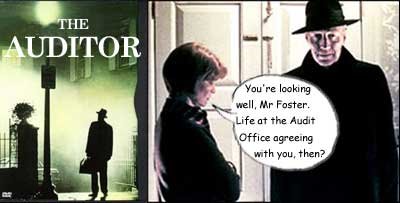
There's some debate going on in comments at present between various anonymii as to just what the Auditor General does when presented with an LTCCP such as the one excreted in secret by the Wanganui District Council recently.
No less an authority than the Mayor himself told anxious ratepayers that "it's difficult to escape the conclusion that we are receiving extra scrutiny this time as a consequence of inadequacies in the last LTCCP published in 2003".
But "the AG does not query monetary specifics of the LTCCP they question processes that were followed in order to reach the LTCCP conclusions," claimed one anonymous, in supposedly defending Council.
With the spin from Guyton Street taking off in opposing directions, Watchers' trying to follow it all risk having their heads mimic that of the girl in The Exorcist.
So here's the real oil, starting with the Local Government Act 2002, from whence the Auditor-General's authority derives, specifically under sections 84(4) and 94 of the Local Government Act 2002.
84. Special consultative procedure in relation to long-term council community plan —There's a whole raft of checklists, presentations and newsletters from the Auditor General explaining the procedure and setting out what it is they're looking for. While we can't claim to have read every word, this section of the document handily entitled "Audit guidance for assessment of significant forecasting assumptions, uncertainties and risks underlying financial estimates in LTCCPs":
(4) A statement of proposal to which subsection(1) or subsection (2) applies must also contain a report from the local authority's auditor on —
(a) the extent to which the statement complies with the requirements of this Act; and
(b) the quality of the information and assumptions underlying the forecast information provided in the statement; and
(c) the extent to which the forecast information and proposed performance measures will provide an appropriate framework for the meaningful assessment of the actual levels of service provision.
(5) For the avoidance of doubt, the report under subsection (4) must not comment on the merits of any policy content of the statement.
94. Audit of long-term council community plan—
(1) The long-term council community plan must contain a report from the local authority's auditor on —
(a) the extent to which the local authority has complied with the requirements of this Act in respect of the plan; and
(b) the quality of the information and assumptions underlying the forecast information provided in the plan; and
(c) the extent to which the forecast information and performance measures provide an appropriate framework for the meaningful assessment of the actual levels of service provision.
(2) A report under subsection (1) may be in the form of confirmation or amendment of the report made by the auditor under section 84(4).
(3) For the avoidance of doubt, a report under subsection (1) must not comment on the merits of any policy content of the plan.
Audit Procedures
The Auditor should, as early as possible:
1. Ascertain the significant underlying assumptions (SAs) the Council intends to apply in preparing the LTCCP.
2. Review the completeness and reasonableness (neither optimistic or pessimistic) of the SAs having regard to:
• the capacity of the Council and its policies and strategies;
• the source and reliability of supporting evidence;
• the categories of assumptions listed in Appendix 1;
• assumptions being applied by other Councils to comparable circumstances;
• the inter-relationship between the SAs (the should be consistent); and
• the past performance of the entity and other similar entities or information which can be otherwise corroborated.
3. Immediately raise, and seek to resolve, any issues with the Council.
The Auditor should, throughout the course of the audit:
4. Be on alert for any inherent assumptions whose reasonableness should be assessed and should be disclosed in the LTCCP.
5. Ensure the SAs are applied consistently over the 10 year period of the LTCCP (this should be covered in key controls testing. If it has not it will need to be covered as part of this testing).
The Auditor should, towards completion of the audit:
6. Ensure all SAs of which the Auditor is aware are adequately disclosed.
7. Ensure any SAs with a high level of uncertainty are identified and disclosed and an estimate of the effect of the uncertainty on the financial estimates is given.
 Clear now? Good. But what it all seems to be saying is that no, the Audit Office can't comment on whether, say, extending a swimming pool when you have no money is in fact a foolhardy decision.
But they can comment on whether the Council has adequately assessed the risks involved, including the effect on adequate levels of service provision, and whether the significant underlying assumptions on which the plan is based (such as "we'll somehow raise $300,000 when all we've managed so far is a car raffle") are reasonable.
So, put simply, the Audit office isn't allowed to tell the Diva that rushing headlong towards a fiscal cliff face with his eyes shut isn't a good idea, but it's quite within it's rights to question whether he's fully cogniscent of the extent of the splat when he hits the bottom.
Won't that be interesting... when it finally comes out, that is.
Comments on this post are now closed.